Advanced Automatic Thickness Gauge Control (AGC) Algorithms and Actuator Integration 2026
Automatic Thickness Gauge Control (AGC) is a closed-loop system that continuously measures film thickness across the width and adjusts the die gap locally to correct deviations. The system consists of a scanning thickness gauge (beta, X-ray, or NIR), a control computer with algorithms, and actuators (thermal bolts or piezoelectric) on the die. The gauge scans the film at high speed (50-200 scans per minute) and generates a thickness profile. The AGC computer compares the profile to the target and calculates corrections for each die bolt. The corrections are applied as heat (thermal bolts) or voltage (piezoelectric) to change the die gap. The control algorithm is typically a PID with feedforward from process parameters (speed, output). The gain, deadband, and integration time must be tuned to avoid oscillation. Thermal bolts have a response time of 1-3 minutes, so the algorithm must be slower; piezoelectric actuators have sub-second response, enabling faster correction. In summary, AGC is essential for achieving tight thickness tolerances (±2-3%). The tuning of the algorithm and the health of the actuators are critical. The operator should monitor the AGC's performance (profile variability) and adjust tuning if needed. In conclusion, advanced AGC algorithms and actuator integration are key to achieving consistent film thickness, reducing material waste and improving quality.
The AGC algorithm must also handle profile shifts (the gauge centering relative to the die). The profile shift can be corrected by a "profile shift" function that adjusts the bolt correction pattern. The algorithm should also have a deadband to avoid unnecessary adjustments for small variations. The actuators must be properly maintained; for thermal bolts, the heaters must be checked for resistance; for piezoelectric, the driver voltage must be verified. In practice, the operator should review the AGC correction history; if the same bolts are constantly adjusted, it indicates a systematic issue (e.g., cooling asymmetry). The operator should then investigate the root cause rather than relying on AGC to compensate. In conclusion, advanced AGC control is a powerful tool for achieving uniform film thickness, but it requires careful tuning and maintenance of the actuators.
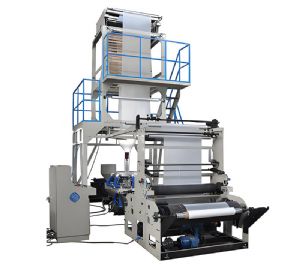
Blown Film Machine
AGC parameters: Gain (Kp): set to avoid oscillation; start low, increase until oscillation, then reduce by 30%. Deadband: ±1-2% of target thickness. Integration time (Ti): match actuator response (thermal: 3-5 scans; piezoelectric: 1-2 scans). Derivative (Td): low value to dampen. Actuator types: Thermal bolts: response 1-3 min, cost-effective. Piezoelectric: response <100 ms, expensive. Profile shift: corrects gauge centering drift. In practice, the operator should perform a step test to determine actuator response and tune accordingly. In conclusion, advanced AGC control is essential for tight thickness tolerances.
