Advanced Automatic Thickness Control and Roll Transfer Strategies for High-Speed Lines 2026
In high-speed blown film lines, the AGC system must maintain thickness tolerance within ±2-3% despite the short time available for correction. The AGC algorithm is typically a hybrid of feedback (from the gauge) and feedforward (from process parameters). The feedforward component predicts the effect of changes in line speed, extruder output, or cooling on the thickness profile and pre-adjusts the die bolts. The feedback component corrects residual errors. The AGC gain must be tuned to avoid oscillation; the deadband is set to ±1% to avoid unnecessary adjustments. The use of fast actuators (piezoelectric) allows correction of high-frequency variations (up to 10 Hz). The gauge scan speed must be synchronized with the line speed; the profile update rate is typically 10-20 Hz. In summary, the AGC for high-speed lines requires a sophisticated control architecture that combines feedforward and feedback, with fast actuators and high-speed scanning. The tuning is critical; too aggressive causes oscillation, too slow causes drift. The operator must monitor the AGC performance and adjust if needed. The system also includes a profile shift function to compensate for any drift in the die or gauge centering.
The automatic roll transfer on the turret winder is another critical operation at high speeds. The transfer must be smooth to avoid any speed change or tension spike. The winder typically has two or three winding stations on a rotating turret. When a roll reaches the target diameter, the turret rotates, bringing an empty core into the winding position. A cut-off knife cuts the film, and a transfer mechanism attaches the film to the new core using an adhesive or a vacuum. The transfer is synchronized with the line speed; the line does not stop. The tension control must be adjusted during the transfer to prevent telescoping. The splice quality is inspected; any defect causes waste. The winder's control system uses a dancer roll and load cells to maintain constant tension. The transfer cycle is typically 2-5 seconds. In practice, the operator monitors the winder for any misalignment; regular maintenance of the cut-off knife and transfer mechanism is essential. In conclusion, the automatic roll transfer is a key enabler of high-speed production, allowing continuous operation without slowing down. Its reliability depends on precise synchronization and robust mechanical design. The AGC and winder transfer together ensure that high-speed lines produce consistent quality with minimal waste.
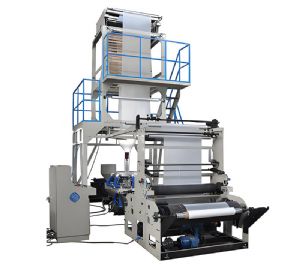
Blown Film Machine
AGC optimization strategies: – Feedforward from line speed, extruder speed, and cooling. – Feedback from gauge profile with fast PI or PID. – Use of predictive (MPC) control for multi-variable. – Actuator selection: piezoelectric for fast response, thermal for slow. – Scan speed matching: gauge scan speed must be > line speed / profile period. – Tuning: gain, deadband, integration time. – Profile shift compensation for centering drift. Winder transfer strategies: – Turret rotation speed: fast to minimize transfer time. – Cut-off knife: sharp, heated if needed. – Transfer mechanism: adhesive tape or vacuum. – Tension control: load cell feedback during transfer. – Splice inspection: camera to detect defects. – Maintenance: sharpen knife, clean suction holes, calibrate tension sensors. In practice, the winder transfer is often the limiting factor for line speed; upgrading to a faster turret and transfer system can increase overall output. In conclusion, advanced AGC and roll transfer strategies are essential for high-speed automatic blown film lines, enabling continuous high-quality production with minimal scrap.
