Advanced Anti-Drip and Thermal Retention Additive Technology in Greenhouse Films 2026
Anti-drip additives are surfactants that reduce the surface tension of water, preventing droplets from forming on the inner surface of greenhouse films. These surfactants are typically fatty acid esters or polyglycerol esters, which migrate to the surface over time. The migration rate depends on the additive's molecular weight and the film's temperature. The anti-drip effect must last for the film's service life (3-5 years); therefore, a reservoir of additive is needed in the inner layer, and its migration is controlled by the layer thickness and polymer matrix. The processing of anti-drip additives requires careful temperature control to avoid degradation. The additives are often fed as masterbatch (5-10%). The film's anti-drip performance is tested by measuring the contact angle of water droplets; a contact angle <90° indicates good anti-drip. Thermal retention additives are infrared absorbers (e.g., metal oxides like zinc oxide or titanium dioxide) that reflect or absorb IR radiation, reducing heat loss from the greenhouse. These additives are placed in the core layer. The particle size and dispersion are critical for performance; agglomeration reduces efficiency and causes haze. The extrusion line must homogenize the additive thoroughly; a mixing screw is recommended. In summary, the additive technology in greenhouse films is essential for their functionality. The line must be capable of processing these additives without degradation and ensuring uniform distribution. The operator must monitor the additive feed rates and film properties.
The interaction between anti-drip and thermal retention additives can affect film clarity and mechanical properties. The surfactants may migrate to the surface, reducing haze slightly. The IR absorbers increase haze, which is acceptable for light diffusion. The processing conditions must be optimized to minimize additive degradation; lower melt temperatures and shorter residence times are beneficial. The die temperature must be uniform to prevent premature migration of anti-drip surfactants. The film's surface energy is modified by the surfactants, which can affect sealing and printing. In practice, the film's performance is validated by field tests. The line's screw and barrel must be cleaned regularly to prevent additive buildup. In conclusion, anti-drip and thermal retention additives are key to greenhouse film performance, and their processing requires careful control of temperature, mixing, and additive feed rates to achieve the desired long-term functionality.
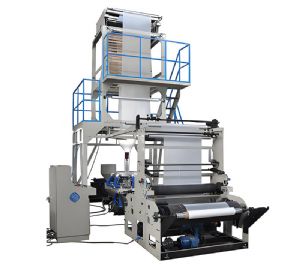
Blown Film Machine
Key additive types: – Anti-drip: fatty acid esters, polyglycerol esters (inner layer). – Thermal retention: IR absorbers (zinc oxide, titanium dioxide) in core. – UV stabilizers: HALS, benzophenones (outer layer). – Light diffusers: calcium carbonate, silica (core). Processing guidelines: – Feed rate: 5-10% masterbatch for anti-drip, 2-5% for IR absorbers. – Melt temperature: 190-220°C; avoid overheating. – Screw: barrier with mixing section for uniform dispersion. – Die temperature: uniform to prevent additive migration. – Cooling: moderate to avoid haze. Quality tests: – Anti-drip: contact angle <90°. – Thermal retention: IR transmission measurement. – Haze: 20-40% for light diffusion. – UV stability: accelerated weathering test. In practice, the additive masterbatches must be stored properly to prevent moisture absorption. The operator should regularly check the film's surface properties. In conclusion, advanced additive technology is crucial for high-performance greenhouse films, and the blowing equipment must be adapted to process these materials consistently.
