Advanced Air Ring Aerodynamics and Heat Transfer Optimization for Blown Film 2026
The air ring is the primary cooling device in a blown film line, and its performance is governed by the aerodynamics of the air jet impinging on the bubble surface. The air ring delivers a high-velocity air stream that removes heat from the molten film through forced convection. The heat transfer coefficient (h) is a function of the air velocity (V), the air density (ρ), the viscosity (μ), and the thermal conductivity (k). The relationship is typically h ∝ V^n, where n is around 0.6-0.8 for turbulent flow. Therefore, increasing air velocity significantly enhances cooling. The air ring pressure (measured as static pressure at the blower) is directly related to the air velocity through the Bernoulli equation; higher pressure yields higher velocity, but also increases power consumption and noise. The air flow rate (m³/h) is the product of the air velocity and the cross-sectional area of the air ring lip. The air ring design includes the lip gap (the annular opening) and the vane angle, which determine the air flow pattern. A dual-lip air ring provides a primary and a secondary air stream, allowing independent control of cooling intensity and stability. The primary stream provides most of the cooling, while the secondary stream stabilizes the bubble and reduces oscillation. The vane angle adjusts the air's impingement angle; a tangential angle (0-15°) helps stabilize the bubble, while a more perpendicular angle (30-45°) enhances cooling but may cause turbulence. In summary, the air ring's aerodynamic design is a balance between heat transfer and bubble stability. The optimal settings depend on the resin, the film thickness, and the line speed. The blower must have sufficient capacity to deliver the required flow at the required pressure; a VFD allows speed control to adjust cooling. In practice, operators set the blower speed to achieve the desired frost line height, and then fine-tune the vanes for uniform cooling. Regular cleaning of the air ring is essential to maintain flow uniformity.
The heat transfer from the bubble to the air is a complex process that involves the interaction of the air jet with the bubble's moving surface. The bubble's surface is also cooling by radiation (to the environment) but convection dominates. The heat transfer coefficient can be estimated using empirical correlations for impinging jets, but the actual value depends on the air ring's design and the bubble's shape. CFD simulations are increasingly used to optimize air ring design. The air ring's pressure drop is determined by the lip gap and the vane geometry; a smaller gap increases velocity for the same flow, but also increases pressure drop. The blower must be sized to overcome this pressure drop at the required flow. The air temperature also affects cooling; chilled air (5-15°C) increases the temperature difference, enhancing heat transfer. However, chilled air increases the density and viscosity, slightly affecting the flow pattern. In summary, the air ring is a sophisticated aerodynamic device that must be designed and operated to achieve uniform, efficient cooling. The interaction between pressure, flow, and heat transfer is non-linear, making it essential to use measurement and control. The use of a flow meter and pressure transducer allows monitoring; the operator can adjust the blower speed and vanes based on the frost line and bubble stability. In conclusion, air ring aerodynamics and heat transfer are at the core of blown film cooling. Optimizing these parameters enables higher speeds and better film quality.
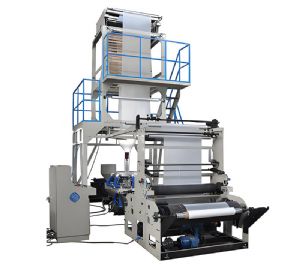
Blown Film Machine
Key aerodynamic parameters: – Air velocity (m/s): typically 20-40 m/s at the lip. – Air flow rate (m³/h): determined by bubble diameter and cooling demand. – Static pressure (Pa): measured at blower outlet. – Lip gap (mm): affects velocity and pressure drop. – Vane angle: affects impingement and stability. – Air temperature: ambient or chilled. – Air density: affected by temperature and humidity. Effects of these parameters: – Higher velocity → higher heat transfer → lower frost line. – Higher flow → more cooling → lower frost line. – Higher pressure → more blower power, but may allow smaller gap. – Chilled air → higher temperature difference → better cooling. – Vane angle: more tangential → more stability, less cooling; more perpendicular → more cooling, less stability. Tuning procedure: – Set blower to 60% speed, observe frost line. – Increase speed to lower frost line; decrease to raise. – Adjust vanes to achieve uniform frost line around circumference. – If bubble oscillates, reduce speed or increase tangential angle. – If cooling insufficient, consider chilled air or IBC. – Record settings for each product. In conclusion, air ring optimization is a vital skill for blown film operators. By understanding the aerodynamics and heat transfer, they can achieve the best balance of cooling and stability, maximizing output and quality.
