Advanced Air Ring Aerodynamic Design and Cooling Efficiency Optimization 2026
The air ring is the primary cooling device in blown film, and its aerodynamic design determines the heat transfer rate and cooling uniformity. The air ring directs a high-velocity air stream onto the bubble surface, removing heat through forced convection. The heat transfer coefficient (h) is proportional to the air velocity to the power of 0.6-0.8 (h ∝ V^0.6-0.8), so increasing air velocity significantly improves cooling. The air ring's lip gap and vane angle control the air velocity and flow pattern. A dual-lip air ring provides a primary and secondary air stream, allowing independent control of cooling intensity and stability. The primary stream provides most of the cooling; the secondary stream stabilizes the bubble and reduces oscillation. The vane angle determines the impingement angle; a tangential angle (0-15°) enhances stability, while a more perpendicular angle (30-45°) increases cooling but may cause turbulence. The air ring must be centered on the die; any eccentricity causes uneven cooling and gauge bands. In summary, optimizing the air ring design involves balancing cooling intensity, uniformity, and stability. The operator should adjust the vanes to achieve a symmetric frost line. The use of a smoke test can visualize airflow symmetry. The air ring should be cleaned regularly to prevent flow disruption. In conclusion, advanced air ring optimization is essential for achieving high cooling efficiency and uniform film properties, enabling higher speeds and better quality.
The cooling efficiency can be further enhanced by using chilled air (5-15°C), which increases the temperature difference between the melt and the cooling air. The chilled air requires a chiller and insulated ducts to prevent condensation. The air ring's blower should have a VFD to adjust air flow; the control system should maintain a constant frost line by varying the blower speed. The air ring's design should also consider the bubble's neck-in; the air flow pattern should compensate for the natural narrowing of the bubble. In practice, the operator should monitor the frost line height and adjust the air flow and vane angles to maintain it within the target range. The air ring's performance is also affected by the ambient temperature; seasonal adjustments may be needed. In conclusion, advanced air ring optimization, combined with chilled air and VFD control, provides the best cooling performance, enabling high-speed production with consistent quality.
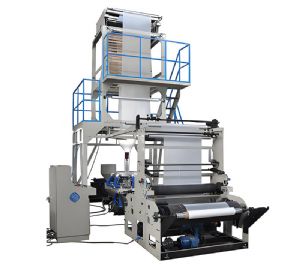
Blown Film Machine
Key air ring parameters: Lip gap: determines air velocity; smaller gap increases velocity but also pressure drop. Vane angle: tangential (0-15°) for stability; perpendicular (30-45°) for cooling. Air velocity: 20-40 m/s at the lip. Air flow: based on bubble diameter and cooling demand. Air temperature: ambient or chilled (5-15°C). Centering: must be concentric with die. Tuning: adjust vanes for symmetric frost line; use smoke test. Benefits: Chilled air: +20-30% cooling capacity. Dual-lip: better stability and uniformity. VFD: precise control. In practice, the operator should document air ring settings for each product. In conclusion, advanced air ring optimization is a key technology for achieving high cooling efficiency and stable bubble operation.
