Advanced Additive and Resin Effects on Optical Clarity in Blown Film: Slip, Anti-Block, and Nucleating Agents 2026
Additives commonly used in blown film, such as slip agents (e.g., erucamide) and anti-block agents (e.g., silica, talc), can significantly increase haze by creating surface roughness and internal scattering. Slip agents migrate to the surface and form a microcrystalline layer, which scatters light, increasing haze. Anti-block particles create physical protrusions on the surface, also increasing haze. To minimize haze, the minimum effective levels of these additives should be used. For high-clarity films, slip agents may be omitted or used at very low levels (0.05-0.1%). Anti-block can be replaced with organic anti-block agents (e.g., fatty acid amides) that have less impact on haze, or the particle size can be reduced. Nucleating agents (e.g., sorbitol derivatives) can be added to promote the formation of many small spherulites, reducing haze. These are effective in PP and some PE grades. The resin type also plays a role: LDPE has higher haze than LLDPE due to its branching; mLLDPE, with its narrow molecular weight distribution, provides the best clarity. Blending LDPE with LLDPE can improve clarity somewhat. In summary, additive levels and resin selection are crucial for optical clarity. Converters should use the minimum additive levels required for functionality, and choose resins with inherent clarity (mLLDPE). Nucleating agents can be considered for high-clarity applications. The operator should test different formulations to find the optimal balance of clarity and performance.
The interaction between additives and processing conditions also affects haze. For example, higher processing temperatures can cause slip agents to migrate more, increasing haze. Faster cooling can reduce the migration time, potentially lowering haze. The die temperature and cooling rate should be optimized for the specific additive package. In practice, the quality control lab should measure haze on each batch. If haze is high, check the additive feed rates and adjust. Also, check the resin certificate for any batch-to-batch variations. In conclusion, additive and resin selection are key levers for controlling haze in blown film. By carefully selecting materials and minimizing additive levels, and by optimizing processing conditions, converters can achieve the clarity required for high-end packaging applications.
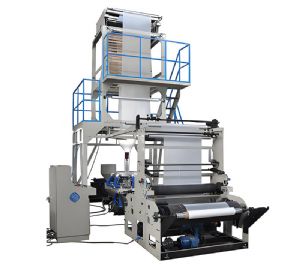
Blown Film Machine
Additive effects: Slip agents (erucamide, oleamide): increase haze by surface crystallization. Anti-block (silica, talc): increase haze by surface roughness. Organic anti-block: less impact on haze. Nucleating agents (sorbitol): reduce haze by promoting small spherulites. Processing aids (fluoropolymers): may reduce haze by improving surface smoothness. Resin selection: LDPE: higher haze, good clarity. LLDPE: moderate haze, better strength. mLLDPE: lowest haze, high clarity. Blends: LDPE/LLDPE blends can improve clarity over pure LLDPE. Recommended levels: Slip: 0.05-0.2% for clarity; higher for slip. Anti-block: 0.1-0.5% minimum. Nucleating agents: 0.1-0.3% for PP, 0.05% for PE. Test methods: Haze per ASTM D1003. Gloss per ASTM D523. Visual inspection under light. Optimization: Start with minimum additive levels, increase only if needed for handling. For high-clarity films, use mLLDPE and minimize additives. Consider using a separate slip layer in multi-layer films. In practice, the operator should work with the resin and additive suppliers to develop a formulation that meets both clarity and functional requirements. In conclusion, advanced additive and resin management is essential for achieving high optical clarity in blown film, enabling converters to meet the demands of transparent packaging applications.
