Advanced Active and Passive Bubble Stabilization Techniques for High-Speed Blown Film 2026
Bubble instability is a major limitation for high-speed blown film production. Two categories of stabilization techniques are used: passive (mechanical) and active (control-based). Passive techniques include bubble cages (guide rings) that physically constrain the bubble, preventing lateral movement. The cage consists of 2-4 rings with adjustable diameter, placed above the frost line. The rings are slightly larger than the bubble (10-20 mm clearance) and are made of polished stainless steel. They provide support without contacting the film. Passive stabilizers also include collapsing frame adjustments and nip roll alignment. Active techniques involve controlling the internal pressure in response to oscillations. A pressure transducer measures the internal pressure; a fast-acting valve modulates the pressure to counteract the oscillation frequency (typically 0.5-5 Hz). This requires a control algorithm that detects the oscillation phase and applies a counter-signal. Active damping can reduce oscillation amplitude by 50-80%, enabling higher speeds. In summary, a combination of passive and active techniques provides the best stabilization. The bubble cage is a simple, cost-effective first step. For high-speed lines, active damping is recommended. The operator should tune the active damping parameters based on the observed oscillation frequency. In conclusion, advanced stabilization techniques are essential for high-speed blown film production, allowing converters to push line speeds while maintaining quality and stability.
The bubble cage must be properly installed: the rings should be centered on the bubble and adjusted to provide uniform support. The ring height should be set just above the frost line. The cage should be cleaned regularly to prevent polymer buildup. Active damping requires a high-speed valve and a controller with fast analog I/O. The control algorithm can be a simple phase-locked loop or a more advanced adaptive filter. In practice, the operator should first optimize passive measures (cooling balance, temperature), then add the cage, and finally consider active damping. In conclusion, the combination of passive and active stabilization techniques provides a comprehensive solution for bubble stability, enabling high-speed production with consistent quality.
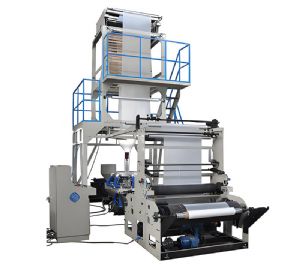
Blown Film Machine
Passive techniques: Bubble cage: 2-4 rings, adjustable diameter. Guide rings: similar, integrated with collapsing frame. Collapsing frame adjustment: symmetry and angle. Nip roll alignment: even pressure. Active techniques: Pressure transducer: measures internal pressure. Fast-acting valve: modulates pressure. Controller: detects oscillation frequency and applies counter-pressure. Tuning: phase and amplitude adjustment. Benefits: Passive: simple, low cost, effective for moderate speeds. Active: high effectiveness, enables higher speeds. Combined: best performance. In practice, the cage is often the first upgrade; active damping is for high-end lines. In conclusion, advanced bubble stabilization techniques are key to achieving high-speed blown film production, reducing scrap and enabling consistent quality.
