Advanced AGC Tuning and Actuator Response Optimization for Thickness Profile Correction 2026
Once a thickness variation is identified as a real profile error (not measurement noise), the Automatic Gauge Control (AGC) system must correct it. The AGC's effectiveness depends on the tuning of its control parameters and the response time of the die bolt actuators (thermal or piezoelectric). The primary tuning parameters are: proportional gain (how aggressively the system responds to an error), deadband (the error magnitude below which no correction is made), and integration time (how long the system averages the error before acting). Too high a gain causes oscillation (the profile overshoots and undershoots); too low a gain results in slow correction. The deadband prevents unnecessary adjustments for small variations that are within specification; it is typically set to ±1-2% of the target thickness. The integration time should be set to the time constant of the actuator response; for thermal bolts (response time ~1-3 minutes), a longer integration time (e.g., 3-5 scans) is needed; for piezoelectric actuators (response time <100 ms), a shorter integration time (1-2 scans) is suitable. The AGC also includes a "profile shift" feature to compensate for any drift in the gauge's centering relative to the die. In summary, AGC tuning is a critical skill. The operator should use a step-change test: introduce a small disturbance (e.g., change a bolt heater setpoint) and observe the profile response to determine the system's time constant. Then set the AGC parameters accordingly. Regular review of AGC performance (e.g., profile variability over time) helps identify when re-tuning is needed.
The actuator response time is a key limitation. Thermal bolts operate by heating or cooling the bolt, which expands or contracts, moving the die lip. The thermal time constant is determined by the bolt's mass and the heater power; typical response times are 1-3 minutes. This limits the AGC's ability to correct high-frequency variations (e.g., from surging). Piezoelectric actuators offer sub-second response, enabling correction of dynamic variations, but they are more expensive and require high-voltage drivers. For thermal bolts, the AGC algorithm should include a predictive element: after a correction is applied, the system should wait for the response to stabilize before making further corrections. The operator should also ensure that the bolt heaters are functioning properly; a stuck bolt will not respond to AGC commands, causing persistent gauge bands. In practice, the AGC system should have a "performance monitor" that tracks the correction activity; if the same bolts are constantly adjusted, it indicates a systematic issue (e.g., cooling asymmetry). The operator should then investigate the root cause rather than relying on AGC to compensate. In conclusion, proper AGC tuning and actuator maintenance are essential for effective thickness profile correction. The operator must understand the actuator dynamics and adjust the control parameters accordingly, and regularly check the health of the actuators.
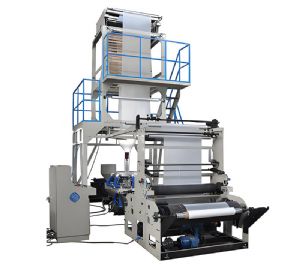
Blown Film Machine
AGC tuning parameters: Proportional gain (Kp): start with 0.5, increase until oscillation appears, then reduce by 30%. Deadband: set to ±1-2% of target thickness. Integration time (Ti): set to 2-4 scan periods for thermal bolts, 1-2 for piezoelectric. Derivative (Td): used to dampen overshoot, typically 0.1-0.2 times Ti. Update rate: match actuator response; for thermal, 1 correction per 2-3 scans. Profile shift: adjust if gauge centering drifts. Actuator types: Thermal bolts: response time 1-3 min, cost-effective, widely used. Piezoelectric: response time <100 ms, expensive, for high-speed lines. Maintenance: Check bolt heater resistance regularly. Clean bolt contacts. Verify bolt movement with dial indicator. For piezoelectric, check driver voltage. Tuning procedure: 1) Set conservative gain (low) and no deadband. 2) Introduce a step change (e.g., +5% on a bolt). 3) Observe profile response time. 4) Set integration time based on response. 5) Increase gain until oscillation, then reduce. 6) Add deadband to reduce unnecessary adjustments. 7) Verify profile improvement over time. 8) Document settings. In practice, AGC tuning is often done during commissioning and reviewed annually. The operator should be able to manually adjust bolts if AGC is off. In conclusion, optimized AGC tuning and actuator response are key to achieving tight thickness tolerances, reducing material waste and improving film quality.
