Advanced 3-Layer Blown Film Extruder: Process Optimization for Cost-Effective Functional Films 2026
A 3-layer blown film extruder is the most common multi-layer configuration, offering a balance between performance and cost. It consists of three extruders feeding a co-extrusion die, producing films with three distinct layers. The most typical structure is A/B/A, where the outer layers are identical, providing symmetry that reduces warping and ensures balanced properties. The inner layer (A) is often the sealant layer, made of a high-performance material like mLLDPE for low-temperature sealing, while the core layer (B) provides structural strength and can contain recycled material or fillers to reduce cost. The A/B/A structure requires only two different resins (if the outer layers are identical), simplifying material handling. The layer ratio is typically 20/60/20 for sealant/core/outer, but can vary from 10/80/10 to 30/40/30 depending on the application. The 3-layer line is versatile, producing films for shrink wrap, stretch hood, heavy-duty sacks, and agricultural films. The die is usually a feed block type, combining the three melt streams before the die. The control system manages the three extruder speeds to maintain the layer ratios. The investment cost for a 3-layer line is about 1.5-2 times that of a single-layer line, but the added value from improved properties (seal, strength, clarity) justifies the cost. In summary, the 3-layer extruder is the workhorse of the flexible packaging industry, offering a cost-effective way to enhance film performance by separating functions into different layers.
The optimization of a 3-layer line involves selecting the right resins for each layer, setting the layer ratios, and tuning the process parameters. The sealant layer should be chosen for its sealing properties (low temperature, high strength) and must be compatible with the core layer; tie layers are usually not needed if both are polyolefins. The core layer can be a lower-cost resin (e.g., LDPE or recycled PE) to reduce material cost, or a high-strength resin (HDPE) for stiffness. The outer layer should provide printability and toughness. The layer ratios are determined by the required film properties; for example, increasing the sealant layer thickness improves seal strength but increases cost. The process parameters (BUR, melt temperature, cooling) must be optimized for the blend of resins; the temperature profile of the three extruders may differ slightly. The die must distribute the layers uniformly; any asymmetry causes gauge bands. In practice, the operator monitors the film properties and adjusts the extruder speeds to maintain the target layer ratios. The use of NIR gauging for overall thickness is common; layer-specific measurement is less common but available. In summary, optimizing a 3-layer line requires a systematic approach to select the right materials and parameters for each layer, ensuring that the film meets the performance requirements at the lowest possible cost. The 3-layer configuration offers a significant improvement over single-layer, making it a popular choice for converters upgrading from commodity to functional films. In conclusion, the
3-layer blown film extruder is a proven, reliable technology that delivers excellent value for a wide range of packaging applications. Its simplicity relative to higher-layer lines makes it easier to operate and maintain, while still providing the benefits of multi-layer functionality.
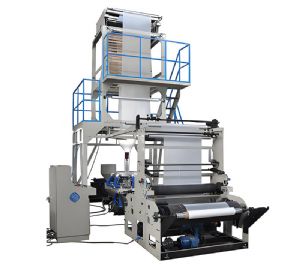
Blown Film Machine
Key layer structures and ratios: – A/B/A symmetrical: sealant/core/sealant or outer/core/outer. – A/B/C asymmetrical: sealant/core/outer with different materials. – Typical ratios: 20/60/20 for cost balance, 30/40/30 for high seal or outer performance. – Core layer often contains recycled content (up to 30%). – Tie layers are not needed if all layers are PE-based. – Outer layer may be treated for printability. Key process parameters: – Each extruder has its own temperature profile based on its resin. – BUR set for overall film properties; affects all layers equally. – Cooling must be uniform to maintain layer symmetry. – Line speed set for target total thickness. – Layer ratio control via extruder screw speeds (or melt pumps). – NIR gauge for total thickness; optional layer-specific. Optimization steps: 1) Define required film properties (seal strength, tear, clarity). 2) Select resins for each layer. 3) Choose layer ratios to meet properties at minimum cost. 4) Set extruder temperatures and speeds. 5) Run trials and measure properties. 6) Adjust ratios and process parameters. 7) Validate final product. In practice, the 3-layer line is often the first step into multi-layer production for converters. It offers a significant jump in capability without the complexity of higher-layer lines. With proper optimization, it can produce high-quality films that compete with more expensive 5-layer structures for many applications.
