7-layer high-barrier film line
A 7-layer high-barrier film line is a state-of-the-art co-extrusion system with seven extruders delivering a complex film structure that often includes two or more barrier layers, multiple tie layers, and specialized surface layers. This configuration is used for the most demanding applications such as retortable food pouches, pharmaceutical blister packaging, high-aroma food (coffee, cheese), and industrial barrier liners. A typical 7-layer structure might be: sealant / tie / EVOH (barrier 1) / tie / PA (barrier 2) / tie / outer layer. This provides both oxygen and aroma barrier (EVOH) and puncture resistance (PA), with the sealant ensuring low-temperature sealing and the outer layer offering heat resistance for retort. The multiple tie layers are essential because PA and EVOH are incompatible with polyolefins. The line requires extremely precise temperature and viscosity control because seven melt streams with different rheologies must flow uniformly without interfacial turbulence. The die is always a multi-manifold type, often with 7 independent spiral mandrels, to ensure each layer is evenly distributed before final merging.
The complexity of a 7-layer line is significantly higher than 5-layer. The control system must manage seven extruder speeds, seven melt pumps, and the die's temperature zones (often 20+ zones). Each extruder has its own barrel temperature profile optimized for its resin – e.g., PA extruder at 240°C, EVOH at 210°C, PE at 190°C. The die must maintain these different temperatures while ensuring the melts don't freeze or degrade. The feed block (if used) must be engineered for such multi-layer combination, but most 7-layer lines use a multi-manifold die to avoid intermixing. The line speed is typically moderate (50-100 m/min) because of the thick total film (often 100-200 µm) and the slow cooling required to avoid warpage. The bubble is larger and requires robust IBC and high-capacity air rings. Thickness control is critical; online NIR gauges can measure each layer, and the AGC adjusts individual extruder outputs to correct layer thickness deviations. The scrap rate is higher due to complex start-ups, but the film's high value offsets this. Applications: retort pouches (ready-to-eat meals), medical device packaging, deep-draw thermoforming films, and multi-layer shrink films for meat.
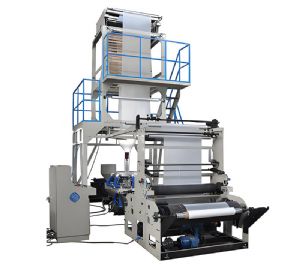
Blown Film Machine
Key benefits of 7-layer high-barrier films: ability to combine multiple barrier functionalities (oxygen, moisture, aroma) in one film, enhanced mechanical strength through layer synergies, excellent thermoformability, and resistance to high temperatures (retort up to 121°C). Typical structures: A/B/C/B/D/B/E (with two barriers and multiple ties) or A/B/C/D/E/F/G for specialized. Material selection: sealant – often mLLDPE or PP for heat resistance; tie – maleic anhydride grafted PE or PP; barrier 1 – EVOH (low ethylene for high barrier); barrier 2 – PA (nylon 6 or MXD6) for oxygen and puncture; outer – often PET or PA for heat and print. The line must be equipped with drying systems for PA and EVOH (hygroscopic). The extruder screws must be designed to minimize shear heating for these heat-sensitive materials. The die gap and BUR are optimized for the total thickness; high BUR (3-4) is common to enhance orientation. Maintenance is intensive: regular cleaning of all mandrels, thorough purging between grades, and frequent calibration of temperature sensors. The line is usually operated by experienced technicians with specialized training.
Economic and operational considerations: the capital cost is very high, often exceeding $2 million for a complete line. The payback relies on producing high-margin films for premium markets. To reduce cost, some lines use recycled core layers (if allowed) between the barrier layers. The line's flexibility to produce fewer layers (e.g., 5-layer) by turning off extruders is a plus. The energy consumption is higher because of multiple heaters and the chiller for IBC. However, the film's superior performance justifies the cost for converters targeting medical, aerospace, or luxury food markets. The trend is toward even higher layer counts (9 or 11) for ultra-high barrier, but 7-layer is often the practical maximum for most operations, balancing complexity and capability. Operator skill is crucial – detecting and correcting delamination, interfacial waves, or gauge bands requires deep understanding of polymer rheology. Many lines have advanced automation with AI-based optimization to assist operators. Overall, the 7-layer high-barrier film line represents the pinnacle of blown film engineering, delivering films that protect and preserve the most sensitive products in the market.
