5-layer barrier film blowing machine
A 5-layer barrier film blowing machine is a co-extrusion line with five extruders and a specialized die to produce films that combine high barrier properties with structural strength and sealability. The typical structure includes: a sealant layer (inner), a tie layer, a barrier layer (e.g., EVOH or PA), another tie layer, and an outer structural layer. This configuration is the minimum required to incorporate an oxygen barrier (EVOH) between polyolefin layers, because EVOH does not adhere to PE or PP without an adhesive tie layer (usually maleic anhydride grafted PE). The barrier layer is very thin (typically 5-15% of total thickness) but provides an oxygen transmission rate (OTR) of <1 cc/m²/day, essential for extending shelf life of perishable foods like meat, cheese, and coffee. The 5-layer line allows independent control of each layer's thickness, enabling precise barrier performance while minimizing expensive barrier resin usage. The extruder sizes are scaled to the layer percentages – the barrier layer extruder can be small (e.g., 30-45 mm) while the structural layer extruders are larger.
The die for a 5-layer machine is usually a multi-manifold or stacked die design, where each layer flows through its own spiral mandrel and they are combined near the die lip. This provides excellent layer distribution and reduces interfacial stress. The feed block approach can also be used but is less common for 5 layers because of viscosity mismatches. The processing temperatures must be carefully managed: EVOH requires around 190-220°C, while PE layers run at 180-200°C, and tie layers are intermediate. The temperature difference must be minimized to avoid freeze-off or degradation. The line speed is often lower than for all-polyolefin films because the barrier resin is heat-sensitive and requires careful cooling. However, with IBC and high-efficiency air rings, speeds of 100-150 m/min are achievable for thin barrier films. The gauge control must ensure uniform barrier layer thickness; an NIR gauge can measure each layer individually. The bubble stability is critical because the barrier layer has high melt elasticity; proper die design and melt temperature are essential. Applications include vacuum packaging, thermoforming films, stand-up pouches, and medical device packaging.
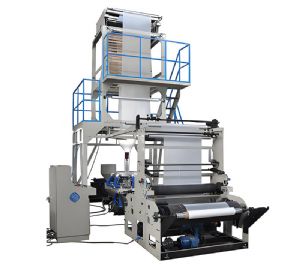
Blown Film Machine
Key advantages of the 5-layer barrier film machine: superior oxygen and moisture barrier, excellent aroma retention, heat resistance for retort applications (if using PA), and good optics. The structure can be symmetrical (A/B/C/B/A) with a central barrier, or asymmetrical for specific functions. Typical materials: sealant – LLDPE or mLLDPE; tie – maleic anhydride grafted PE; barrier – EVOH (with various ethylene content for different barrier levels); outer – PA (for puncture resistance) or HDPE (for stiffness). The line must have precise temperature control for each extruder and the die; even a 5°C deviation can cause interfacial instability. The extruder screws for barrier resins must be designed to minimize residence time to prevent degradation. The screen changers must have fine filtration (e.g., 50 micron) to remove gels that cause pinholes. The winder must handle the film gently to avoid stretching. Regular maintenance includes cleaning the die and feed block, as EVOH residues are sticky and can cause die lines. The line can also produce 3-layer films by turning off the tie and barrier extruders, offering flexibility.
Economic considerations: the barrier resin (EVOH) is expensive (often 3-5 times PE cost), so the line's profitability depends on minimizing its use. The 5-layer design allows barrier layers as thin as 3-5 µm while still maintaining processability. The tie layers also add cost but are necessary. Therefore, the layer ratios are optimized for minimum barrier thickness with adequate tie coverage. The machine's output is typically lower than a 3-layer line of similar extruder sizes because the barrier layer restricts speed. However, the high value of barrier film justifies the investment. For converters, offering 5-layer barrier films opens doors to premium packaging markets. The trend is toward 7-layer and 9-layer machines for even higher performance, but 5-layer remains the workhorse for many medium-high barrier applications. Operator skill is paramount – monitoring melt pressures, temperatures, and layer ratios continuously. Many lines are equipped with automatic layer ratio control using NIR or nuclear gauges. Overall, the 5-layer barrier film blowing machine is a sophisticated yet essential tool for modern flexible packaging, enabling extended shelf life and reduced food waste.
