3-layer blown film extruder
A 3-layer blown film extruder is a co-extrusion system with three extruders feeding a single die to produce film with three distinct layers. It is the most common multi-layer configuration, offering a cost-effective balance between performance and complexity. Typical layer structures are A/B/A (symmetrical) where the two outer layers are identical, or A/B/C where each layer has a different function. The A/B/A structure is popular because it uses only two different resins (the outer layers use the same material) but provides symmetry that reduces warping and ensures consistent sealing. A typical example: outer layers of LLDPE for toughness and sealability, and a core layer of LDPE or recycled material for cost reduction or stiffness. The three extruders can have different sizes – the core extruder is often the largest because the core layer is usually the thickest (40-70% of total thickness). The sealant layer (inner) and outer layer (often for printability or strength) are thinner. The die is usually a feed block type with a spiral mandrel, and the melt streams are combined in the feed block before entering the die.
The 3-layer blown film extruder offers significant improvements over single-layer: it allows using a high-performance sealant resin on the inside (e.g., metallocene LLDPE for low-temperature sealing) without affecting the outer layer's properties. It also enables the use of higher amounts of recycled material or fillers in the core layer, saving cost while the outer layers maintain surface quality. The optical properties can be enhanced by using a clear outer layer and a hazy core, or vice versa. The mechanical properties are also improved – the symmetric structure reduces internal stress and improves tear resistance. The investment cost for a 3-layer line is roughly 1.5-2 times a single-layer line of similar output, but the added value per kg of film is significantly higher. Typical applications: shrink films, stretch hood films, heavy-duty sacks, agricultural films (with UV outer layers), and food packaging films. The line speed and output are similar to single-layer, but the thickness uniformity is generally better because the outer layers can compensate for core variation. The control system must manage three extruder speeds and temperatures; automatic layer ratio control is common to maintain the target thickness percentage for each layer.
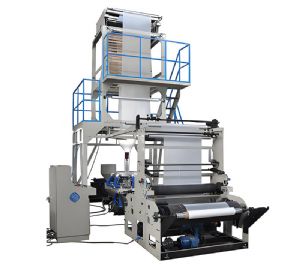
Blown Film Machine
Key technical parameters for a 3-layer extruder: each extruder's screw diameter depends on the layer thickness – for a 100 µm film with 20/60/20 layer distribution, the core extruder may be 90 mm while the outer extruders could be 50 mm each. The die diameter is selected to achieve the desired lay-flat width. Temperature profiles differ per extruder – e.g., the core may run cooler if using LDPE, while the sealant layer may need higher temperature for LLDPE. The feed block must be designed to avoid interfacial instability; the viscosities of adjacent layers should be matched, otherwise waves appear at the interface. Tie layers are not required if the materials are compatible (e.g., all polyolefins). The gauge control system measures overall thickness and, with optional NIR, can estimate individual layer thicknesses. The line can be upgraded to 5-layer later by adding extruders and a more complex die. Maintenance involves regular cleaning of the feed block and die; purging compounds are used during changeovers. The operator must monitor layer ratios by checking weight per unit area of each layer (by gravimetric analysis) or using online NIR. Proper training is essential to avoid delamination and gauge bands.
Practical advice for running a 3-layer line: select resins with compatible melt temperatures – differences within 10°C are ideal. Use a melt pump on each extruder for stable flow. Regularly check the feed block alignment to prevent cross-layer contamination. For recycled core, ensure it is well filtered to avoid gels. The outer layers should be chosen for printability (if needed) and sealing. The line can produce films from 20 µm to 200 µm total thickness. The 3-layer configuration is versatile enough for most packaging needs, making it the most popular choice for medium-sized converters. It offers a sweet spot in terms of investment, operational complexity, and performance improvement. Many manufacturers standardize on 3-layer for their core product lines, reserving 5-layer or higher for specialized applications. With the growing demand for sustainable packaging, 3-layer lines are increasingly used to incorporate post-consumer recyclate in the core, while the virgin outer layers ensure food contact compliance. Therefore, the 3-layer blown film extruder will remain a cornerstone of the flexible packaging industry for years to come.
